
Transistors are active circuit components. Active meaning the component can control the current in other parts of the circuit.
Bipolar-Junction Transistors (BJTs): Made of two diode junctions, and come in two flavors! NPN and PNP. the “N” and “P” refer to whether the area of semiconductor silicon is doped negatively or positively.
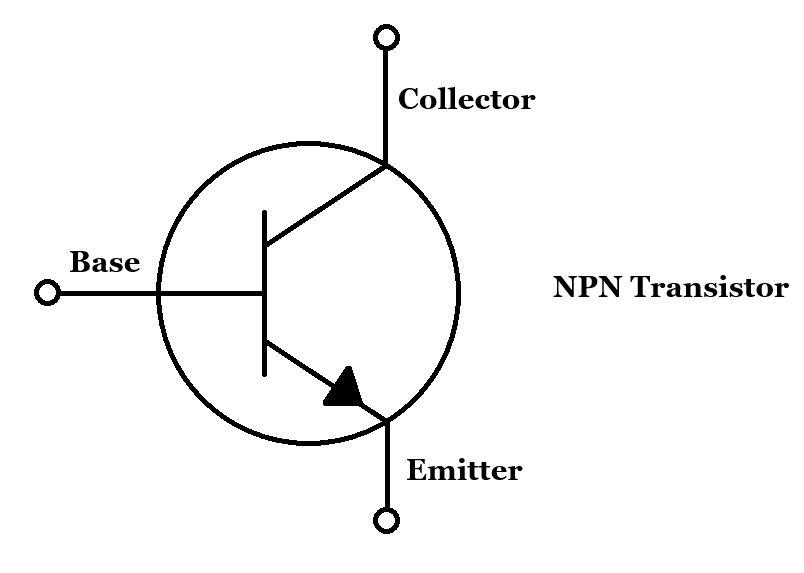

| Current Flows from Collector to Emitter | Current flows from Emitter to Collector |
| Turns on when the Base voltage is GREATER than the Emitter Voltage | Turns on when the Base Voltage is LESS than the Emitter Voltage. |
The Voltage between the base and emitter pins ( ) controls the amount of current that flows between the collector and the emitter.
Since the Base-Emitter junction is really just a diode, will always be resembling 0.7 Volts*
The voltage, , controls the amount of current that flows between the collector and the emitter.

 = Collector Current
 = Reverse Saturation Current
 = Thermal voltage (Approx. 26mV @ 20 deg C).
A Bipolar Transistor operating in the active region also provides current amplification. The current flow through the base pin will be amplified by a transistor parameter known as Beta. ( )
)

therefore:

Saturation region = transistor fully on and acts like a closed switch between the collector and emitter pins.
Cut-Off Region acts as an open switch.
Field Effect Transistors (FETs):
The control pin is called the gate (instead of Base). Current flows between the Drain and the Source.
The Gate is electrically isolated by an isulating oxide layer. No current flows into the gate as it does w/ the Base of the BJT. A FET is purely a voltage-controlled device.


Cut-Off Region:
Threshold Voltage ( ) is the minimum voltage between the gate and source pins (
 ) at which the device begins to turn on. If is less than then no current will flow between the Drain and the Source.
Linear Region:
Sometime called the Ohmic or Triode Mode.
When is greater than the , yet the voltage across the the Drain-Source pins is less than the difference between & , the FET is operating in the linear region.
